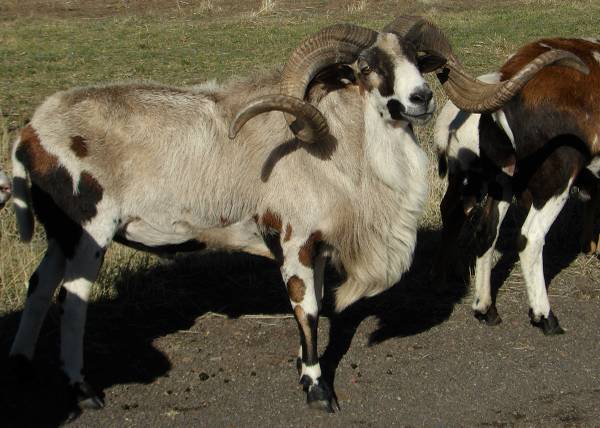
The 2026 beautiful painted desert lambs have arrived!
Painted Desert Sheep are the most beautiful sheep on the planet and one of the easiest breeds of livestock to raise. They are hardy, eat about anything, disease resistance, and require little maintenance, not to mention that they are absolutely gorgeous – each one uniquely colored. All of my lambs can be registered with the Painted Desert Sheep Society (I will provide paperwork upon request) and come from over a decade of selective breeding. Since I used three breeding rams (pictured) and my ewes are from a variety of genetics, I can put together starter flocks (ram with unrelated ewes). Prices range from $150 - $250, with the variation being based on color, size, genetics, and conformation - with the main difference in price being based on color. So, in general, a solid white lamb is $150 and a really "loud" colored lamb that I would rather keep is $250. However, solid or nearly-solid colored sheep can produce loud-colored lambs, and vice versa, so whatever you get will give you a surprise come lambing. Lambs can be weaned at around three months old, which means they will be they will all be ready to go the first week in June. I will hold lambs for you until weaned for a $25 deposit per sheep.
I also have six ewe lambs and one weather lamb (born last October) out of a fourth, unrelated ram who are ready to go now. They will be in another post.
I created a Google Folder with pictures of all the lambs and prices that I keep updated as lambs are sold. If you are interested, send me an email and I’ll send you a link to that folder. You are welcome to come and visit the flock and discuss options and to see if the breed is suitable for you.
I pasted more information on the breed below.
More about Painted Desert Sheep and why they may be a good fit for your property:
Painted Desert sheep are closely related to the American blackbelly sheep (aka, Barbado blackbelly, Barbados, Corsican), which were developed by crossing mouflons (the wild ancestor to domestic sheep, like wolves are the ancestor to domestic dogs) with true Barbado sheep (those without horns) and Merino and Rambouillet sheep (wool breeds). Painted desert sheep are mainly different in term of color and can have influence of Jacob, Navajo Churro, and Texas Dall breeds. Since they come in a variety of dramatic colors and markings, each painted desert sheep is unique. All rams have magnificent horns (a few have more than two horns).
Painted desert sheep are hair sheep, which means they do not need to be sheared, nor do their tails need to be docked. They begin growing a thick undercoat of wool in the fall that thickens as temperatures drop. Males also grow a thick mane, extending from chin to chest. When spring arrives, this wool is shed in great clumps. This characteristic makes the breed adaptable to a wide range of climates and temperature variation. Being closely related to their wild ancestor, they are a very hardy sheep that need very little care.
Ewes can bear lambs close to twice a year, with intervals of about 6-8 months. Painted desert ewes are great mothers and are extremely protective of their lambs. They seldom, if ever, need help lambing. Out of nearly 2,000 painted desert lambs born on my property over the past 13 years, I only had to assist in seven deliveries. In general, lambing just takes minutes, and the new lamb is on its feet in no time nursing from its mother. Twins are generally the rule (except with first time mothers), and triplets are not uncommon.
Painted desert sheep are both grazers and browsers, which means they will eat grass as well as brush and weeds, including star thistle, knapweed, poison oak, blackberry leaves, and Scotch broom. They are thus more versatile than goats, and are easier on fences. The breed does well on marginal feed, much better than larger wool sheep who require higher quality feed.
While smaller side than your traditional market lamb, painted desert sheep do produce a nice carcass that has a much more delicate taste than wool breeds. They do not have the taste of a traditional market lamb such as produced by wool breeds (e.g., Suffolk, Hampshire, Merino, Rambouillet, etc.). Neither the sheep nor their meat has that mutton smell, which is related to the wool and lanoline. You can butcher an older, intact ram and, while the meat would not be as tender as a yearling, it would still taste mild.